


Get Future Homes Standard Ready
The Future Homes Standard (FHS) represents a fundamental shift in home building, creating a clear performance distinction between new builds and the existing housing stock.
Homes built to the FHS will be comfortable, healthy, low-energy, and zero-carbon ready - without the need for expensive retrofit. However, the transition to FHS could carry real delivery and reputational risks if not carefully managed.
A range of homebuilders are already successfully delivering homes that include low‑temperature heating and other FHS technologies, but others are only just beginning.
The FHS Essentials set out seven key practical actions drawn from early adopters. Following these will help homebuilders deliver consistent performance, strengthen the customer experience and reduce risk.
This is a moment of true transformation.
Get Future Homes Standard Ready now.
Introducing the Future Homes Standard Essentials - seven key actions to de-risk delivery today

Gain early, hands-on experience delivering FHS homes to de-risk implementation and ensure readiness for delivery at scale.
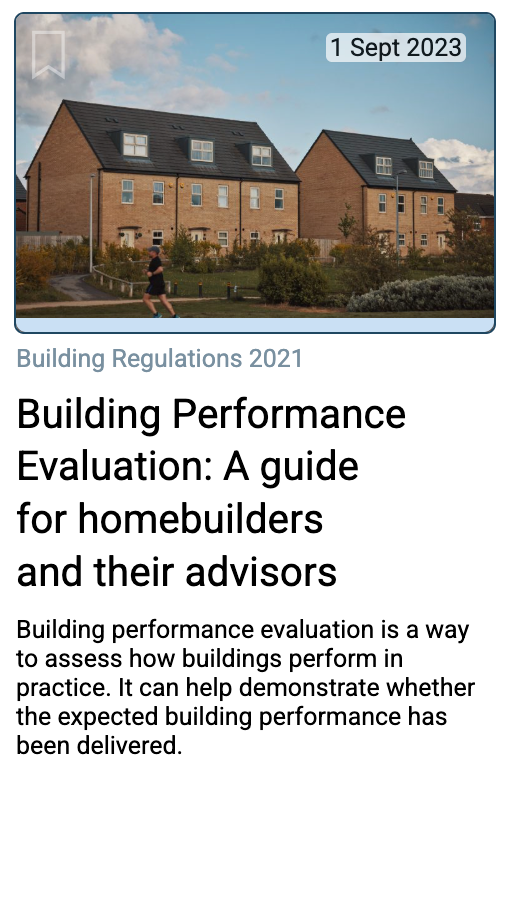
Understanding in-use performance across a sample of homes provides important insights into how design, build quality, and real-world occupant behaviour and lifestyle choices shape outcomes, helping to refine processes and raise standards.
Drive continuous improvement by capturing, embedding and sharing these lessons.
To prepare effectively for the FHS, every homebuilder regardless of size will benefit from establishing pilot sites with a clear, structured plan for embedding learning across their organisation. For those still considering their approach, starting this work now will help manage risk, build confidence and develop the capabilities needed - ready for the regulatory change.
The introduction of the FHS represents a fundamental shift for homebuilders. For the first time, all new homes will be fossil fuel-free, reliant on low-temperature heating systems, and in most cases equipped with photovoltaic (PV) panels. This transition has wide-ranging implications:
- Enhanced electrical infrastructure and grid capacity requirements.
- Revised dwelling and heating system design.
- Increasing importance of accuracy during installation and construction
- Critical importance of commissioning and handover.
- Adapted customer journey.
- Enhanced workforce skills and supply chain capabilities.
Evidence from homebuilders already on this journey shows that success depends on early action, careful planning, and a phased implementation approach. These organisations began with a small number of plots or a single development, resourcing these pilots intensively and applying focused oversight across the seven essential areas of delivery. The lessons learned were then embedded systematically before scaling to whole developments or rolling out across regions.
This structured, iterative approach accelerates learning, reduces risk and builds confidence.
Continuous improvement is critical. Those that formally captured, embedded, and shared lessons across their business found the transition less challenging.
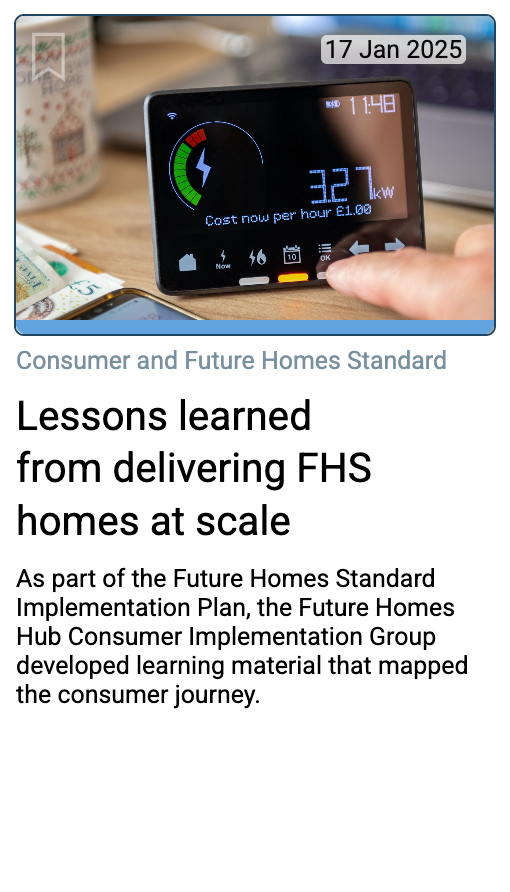
Giving attention to how homes perform in practice and how householders experience them can offer valuable insights. Capturing in-use performance data, and insights from lived experience across a representative sample of homes provides vital feedback. This can directly inform design iterations, strengthen delivery processes, and enhance the customer journey.
Addressing issues early - at pilot scale - allows refinement of solutions, builds confidence, and reduces risks.
Resources available now
Resources under development
Coming soon
Ensuring thermal junction details are built as designed - Hints & Tips for homebuilders
Coming later in 2026
Ensuring good indoor air quality - Where to start guide for homebuilders
Recognise the strategic importance of very early engagement with Network Operators (DNOs / IDNOs) to secure timely and appropriate grid connections for fully electric homes.
For all‑electric housing developments, securing a suitable grid connection is critical and must be considered at the earliest stages so that risks can be factored into land‑purchase decisions and managed through design.
All‑electric homes require greater electrical capacity for heating, hot water, EV charging and the export of PV generation. With other sectors also seeking connections, delivery timeframes could be significantly longer than for gas‑heated schemes. Early engagement with Network Operators (DNOs/IDNOs) is therefore essential.
DNO ‘heatmaps’ and other resources can help identify local constraints, while early conversations — kept confidential by law — allow needs, phasing and optioneering to be discussed. Homebuilders should estimate capacity up front using appropriate guidance for all‑electric homes and share realistic phasing plans, so the network operator understands power‑on timelines.
Choosing the delivery model early — whether applying directly to the DNO or working through an Independent DNO or Independent Connection Provider — is important, alongside appointing a competent client agent to coordinate capacity assessments and manage the application process.
Accurate load assessments and realistic load‑profile phasing help avoid under or over‑estimating demand with the latter potentially causing unnecessary delays and increasing costs. Where grid capacity is constrained, a range of mitigations such as phasing, energy storage, heat networks or smart‑grid solutions can help manage demand. PV export curtailment, albeit temporary, should only be considered as a last resort due to the impact on energy bills.
In short, adequate and timely grid connection is of strategic importance and this needs to be reflected in homebuilder operations.
Resources available now
Resources under development
Coming later in 2026
Grid connections for all-electric homes - Where to start guide for small and micro homebuilders
Grid connections for apartments - Where to start guide for homebuilders
Load shifting and demand side response – Case studies for homebuilders

Ensure the end-to-end customer journey is designed to support householder confidence and customer satisfaction with low-energy homes. Focus on progressively introducing important messaging through the marketing, sales, handover, and aftersales stages.
Feedback from homebuilders already on this journey indicates that homebuyers need a modified customer journey compared with those purchasing familiar gas‑heated homes. Selling a future home requires clarity, empathy, and the confidence to explain new household technologies while shaping realistic buyer expectations. Sales teams must act as educators, able to describe systems such as low‑temperature heating or smart time‑of‑use tariffs in everyday language.
Progressively introducing what it’s like to live in a FHS home, and setting realistic expectations early, is essential for strong satisfaction from day one. This relies on tailored, consistent messaging from initial marketing through the first show home visit and every subsequent interaction, including handover and post‑move‑in support.
By keeping messaging aligned, managing expectations, and providing clear, steady support throughout, teams can help homebuyers feel confident in their decision. Be mindful that messaging remains balanced and evidence‑based so it doesn’t unintentionally overstate benefits. Clear, factual language helps maintain credibility and avoids any perception of greenwashing.
For householders to get the best from their home, it is important they are provided with sufficient knowledge and appropriate training for correct use and maintenance of the new FHS technologies.
Aftercare must also evolve. Rather than focusing solely on fixing issues, should they be raised, it should be more proactive, offering tailored support to help householders get the best from their new low‑energy home.
In short, ensuring that every interaction explains and reinforces the benefits of FHS living strengthens the buying experience and highlights the value of sustainable, future‑ready homes.
Resources available now

Resources under development
Coming later in 2026
Rental customer journey for low energy homes - Hints & tips for landlords & managing agents

Little changes can have big impacts. Carefully considered design decisions will matter more than ever for comfort, health and safety, performance, and cost effectiveness. Substantial changes to Part L 2021 site layouts are not expected to be required, but some adjustments may support optimisation for the FHS. More rigorous attention to detailed design will be needed and this must be captured accurately within the more granular Home Energy Model (HEM).
Whilst full details of the Future Homes Standard are not yet published, a broad outline is known which strongly suggests elements of the homes’ design will need to evolve, such as:
- A range of new products and technologies may be being specified. For example, triple glazing, hot water cylinders, and heat pump installations need careful health and safety design and sequencing considerations due to their size and handling requirements.
- In many cases, the internal layout of homes will need to be adapted to accommodate a hot water cylinder. The integration of other technologies may also require careful spatial planning.
- Paying close attention to the elements of the design that influence thermal performance — from wall build‑ups, window specification and ventilation strategy to junction details and continuity of insulation – is important to ensure comfortable healthy homes and that low‑temperature heating systems perform well.
- The siting of heat pump external units, where used, needs particularly careful thought with small or terraced homes.
- Fabric performance is likely to require modest improvement due to changes expected in the notional building. These, for example, may include slightly lower air permeability and more accurate reflection of the performance of some components, such as windows. Once the FHS is published the full extent will be known.
- A well-designed ventilation system, by someone competent in ventilation design, continues to be essential to ensure good indoor air quality, and its importance only grows as homes rely more on mechanical ventilation.
- More PV is expected to be needed on the majority of homes. Each homebuilder/designer will have different ways of responding to this. Depending on the approach taken, it may influence:
- the optimal roof design of individual homes and house types.
- site layout house type selection - to benefit from advantageous orientations for PV / avoid disadvantageous orientations (particularly south facing plots).
- the diversity of PV orientation across a site to reduce the peak export load for grid connections.
Optimising designs for the FHS requires a genuinely multi‑disciplinary approach. Heating designers, ventilation designers, energy assessors and others need to work together to refine layouts and design details that deliver the required performance. Local policy, design codes and individual homebuilder approaches will influence how this is done.
Resources available now
Resources under development
Coming soon
Ensuring thermal junction details are built as designed - Hints & tips for homebuilders
Ensuring good indoor air quality - Where to start guide for homebuilders
Coming later in 2026
Future Homes Standard (FHS) - Where to start guide for homebuilders and the supply chain (masonry construction)
Future Homes Standard (FHS) - Where to start guide for homebuilders and the supply chain (timber frame construction)
Home Energy Model (HEM) - Where to start guide for homebuilders
Load shifting and demand side response – Case studies for homebuilders

Treat heating system design as a critical technical discipline. Correct system design underpins comfort, efficiency, and customer satisfaction. Partner with competent and experienced heating designers to achieve the best outcomes.
Conventional gas boiler systems are inherently more tolerant to a wider range of design variations. Should there be instances of suboptimal design, with the gas boiler’s higher flow temperatures this shortcoming is less obvious to householders. However, they may still pay more to heat their homes.
By contrast, low‑temperature systems, such as heat pumps, have tighter design margins. As a result, if heat loads are higher than calculated or the heating system underperforms, this is more immediately apparent once the home is occupied. This is typically seen through cold homes or noticeably high energy costs.
This means:
- Not treating heat pump, or other low temperature heating system, schemes the same as those with gas boilers.
- Identifying a single, ‘responsible heating designer’.
- Ensuring the responsible heating designer is competent and experienced in the systems they are designing.
- ·Ensuring the final fabric design is reflected in the final heating system design calculations and energy model.
- Not allowing any deviation from the agreed heating design without authorisation from the responsible heating designer.
In short, low-temperature heating from lower-capacity heat sources demands highly competent and accurate design and component specification.
Resources available now
Resources under development
Coming soon
Heat pumps in SAP - Hints & tips for homebuilders

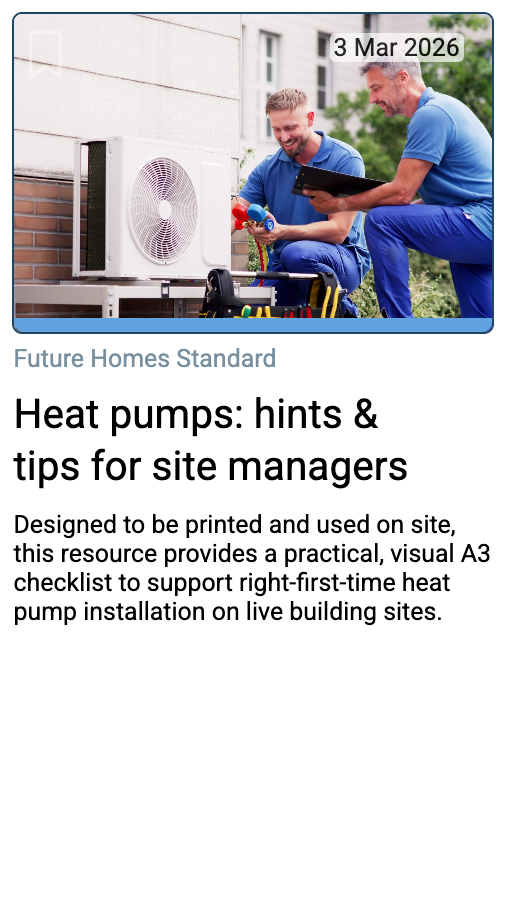
Homes with low temperature heating systems demand greater precision than those with gas boilers. If there are instances of poor installation, weak commissioning or underperforming building fabric, these are likely to become more immediately apparent to householders as cold homes or high energy bills. Key to delivering the intended outcomes is ensuring that the latest design information is available to all trades, is followed accurately and in the agreed sequence, and that any issues arising are referred back to the designer. To avoid trade shortages, actively engage with your installers about their plans for scaling up, particularly for heat pump systems.
As introduced in ‘5 Getting heating design right’, conventional gas boiler systems are inherently more tolerant to a wider range of installation variation. With lower temperature heating systems, even when overall construction quality remains high, any defects that do occur - such as instances of poor installation, weak commissioning or underperforming building fabric - tend to be more apparent to the householder. Typically, this shows up as cold homes or higher than expected running costs. These issues are more likely to prompt complaints and a request for remedial works.
This means:
- An appropriately high health and safety focus when installing new products.
- Ensuring the dwelling fabric is built exactly as designed by a competent workforce and properly supervised.
- Only using competent, properly supervised heating engineers and electricians for heating system installations.
- Ensure the ventilation system is installed exactly as designed by a trained and competent contractor
- Not allowing deviation from the agreed design without authorisation from the responsible fabric, ventilation and/or heating designer
- Requiring that heating installers demonstrate robust plans for cross-skilling from gas to low carbon heating in the run up to the FHS, and supporting this process.
- Confirming with manufacturers that the heat sources (such as heat pumps), cylinder, emitters and controls integrate fully as designed.
- Not accepting equipment / component / material substitutions without responsible heating, ventilation and/or fabric designer approval
- Ensuring that PV panels, inverters and cabling are considered a system, installed by a competent engineer and certified.
In short, more than ever, FHS homes demand precise heating, ventilation and PV system installation and fabric construction.
Resources available now
Resources under development
Coming soon
Ensuring thermal junction details are built as designed - Hints & tips for homebuilders
Ensuring good indoor air quality - Where to start guide for homebuilders

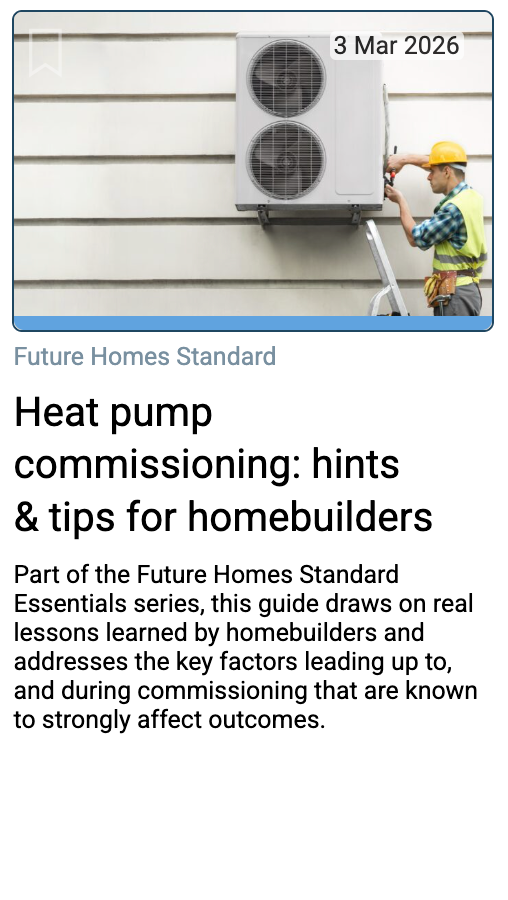
Very close attention must be paid to commissioning and quality assurance. This is essential to ensure systems perform as designed and deliver consistently strong customer outcomes across heating, renewables, and ventilation.
Future Homes Standard homes will have different and/or more technology and systems than is typical in new homes today. To perform well, these systems require careful commissioning by competent and experienced engineers.
For example, lower temperature heating systems, such as heat pumps, which typically have tight design margins, must be comprehensively checked and commissioned by an experienced and competent heating engineer. Experience over the last few years has highlighted this as a critical activity to ensure that the homebuilder can be confident of good outcomes for every home. Some homebuilders have a dedicated heating system commissioning team or arrange for each commissioning to be personally overseen by a competent member of the site or customer care team.
Likewise, PV system commissioning is critical to ensure the system operates correctly and that all safety aspects have been properly addressed.
A thorough approach to the commissioning of ventilation systems continues to be critical in these lower air permeability homes, especially as mechanical ventilation becomes more common. Setting fan air flow, alongside checking other elements such as trickle vents and door undercuts helps ensure the system performs as intended and supports good indoor air quality for householders.
Resources available now
Resources under development
Coming soon:
Ensuring good indoor air quality - Where to start guide for homebuilders