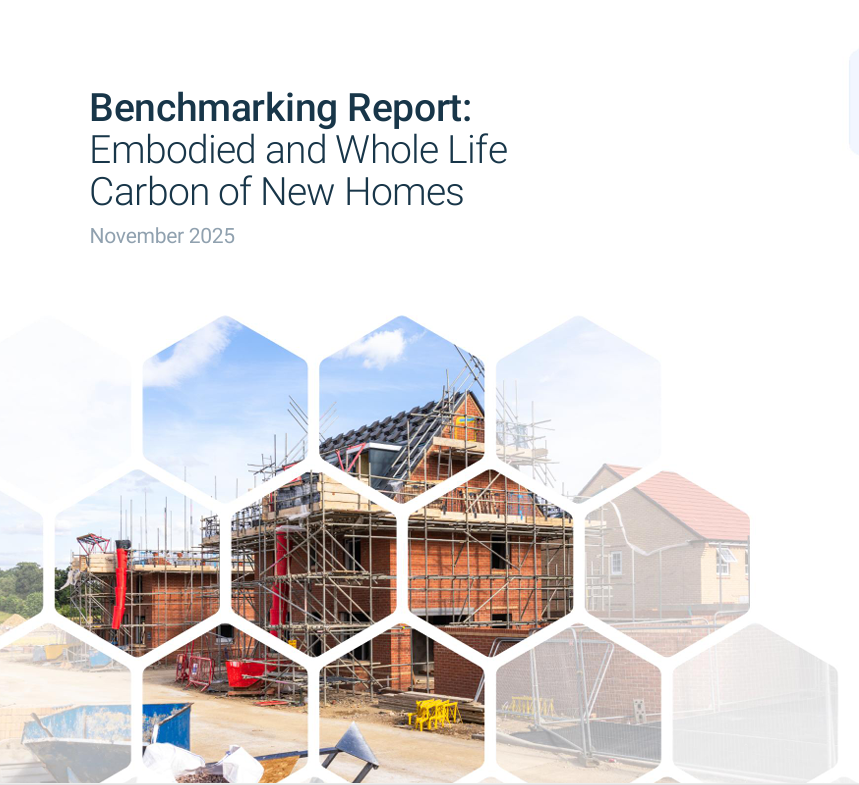
The Future Homes Hub has released its Whole Life Carbon (WLC) Benchmarking Study for 2025, a landmark report addressing a critical knowledge gap in the UK homebuilding industry. For the first time, this study provides a vital, empirically grounded evidence base on the embodied carbon performance of new low-rise housing, guiding the sector’s collective transition to net zero.
The study’s core purpose is to create a robust snapshot of current carbon performance by analysing 48 detailed Whole Life Carbon assessments submitted by 17 industry partners. To ensure consistency, credibility, and comparability across the dataset, all assessments adhere to the rigorous standards outlined in the WLC Conventions for New Homes and RICS Professional Standard 2nd edition.
Establishing a Carbon Baseline
The top-level average (mean) carbon intensity metrics for new homes, derived from the entire dataset, are as follows:
- Upfront Carbon: 406 kgCO₂e/m²
- Whole Life Embodied Carbon: 611 kgCO₂e/m²
To ensure robust, like-for-like comparisons, the scope of these figures covers the building only, excluding development site-level impacts outside the plot boundary. It is clear that the sector needs to develop methods to capture the significant, and rarely measured, carbon impact of infrastructure and external works. However, as it stands, there is insufficient data available to provide a benchmark.
By analysing the data through different characteristics—such as dwelling type, heating fuel, and structural system—the study reveals critical trends and provides actionable insights for developers, designers, and manufacturers.
Comparing Dwelling Types and Structural Systems
The choice of heating system has a profound and complex impact on a home's carbon footprint. The study finds that the upfront embodied carbon impact is similar for homes built with either gas boilers or heat pumps. Indeed, over the building's 60-year lifespan, the whole life embodied carbon of the mechanical, electrical and plumbing systems is on average 21 kgCO2e/m2 greater for homes with a heat pump – approximately 3-4% of the whole building. This difference is likely driven by fugitive refrigerant emissions (the gradual leaking of potent greenhouse gases from the heat pump system during its operational life).
However, this is sharply contrasted and dwarfed by the operational carbon impact. The study's most significant finding in this area is that electric-heated homes with heat pumps have on average 440 kgCO2e/m2 lower operational carbon impact over 60 years compared to homes with gas boilers. This stark contrast – cutting the operational carbon by more than half – is the report's clearest illustration of why a whole-life carbon perspective is non-negotiable for achieving genuine decarbonisation; focusing on upfront carbon alone can lead to strategically flawed, long-term decisions.
Counter-intuitively, the empirical data suggests that detached homes have a slightly lower embodied carbon intensity than terraced homes. This finding runs contrary to some previous modelling, and the report notes that a larger dataset will be required to investigate further.
The data supports conclusions from recent studies when comparing masonry and timber frame structural systems for low-rise housing – with the data showing a lower average upfront and whole life embodied carbon for timer frame examples compared with masonry.
Data Quality and the Call for Product-Specific EPDs
The quality and source of carbon data are fundamental to accurate assessment. A key aim identified in the Hub’s WLC Implementation Plan (2023) was to measure and increase the extent of product-specific EPDs used in assessments.
This report provides a baseline from which to track improvement towards that goal, and it also highlights a clear divergence in practice based on the software used. Assessments submitted via the One Click LCA tool sourced an average of 43% of their material impacts from product-specific Environmental Product Declarations (EPDs). In contrast, only 4 of the assessments (<1% of the carbon impact) submitted via the Hub tool used product-specific EPDs.
Furthermore, the report expresses concern that in the Hub tool assessments, a large proportion (33%) of the total carbon impact is accounted for by 'component benchmarks'. These high-level estimates serve a purpose in simplifying the estimation of carbon impact for complicated and difficult-to-quantify building systems with numerous components. However, they introduce significant uncertainty into the assessments.
These differences result in a much greater overall data uncertainty for Hub tool assessments on average (12%) vs. One Click LCA assessments (5%).
An Industry Perspective: Driving Progress Through Collaboration
This study is a testament to the power of industry collaboration. Its findings were made possible by the homebuilders and consultants who contributed their detailed project data and expert insights, demonstrating a shared commitment to transparency and progress.
"This benchmark is a pivotal moment for the homebuilding sector. For the first time, we have a clear, data-driven picture of our collective starting point on whole life carbon. This isn't just about numbers; it's about providing the tools and transparency our industry needs to set ambitious targets, make smarter design choices, and track meaningful progress. We are immensely grateful to our members who contributed data, and we urge the entire sector to join us in building this evidence base for our shared net-zero future." – Adam Graveley, Head of Technical and Innovation, Future Homes Hub “This collaborative effort provides the essential foundation for the targeted actions needed to accelerate the sector's decarbonisation journey.”
The Path Forward: Next Steps for the Sector
This inaugural benchmark is not an endpoint but a critical foundation for future work. The Future Homes Hub will continue to gather data to refine these benchmarks and has identified several key opportunities for the sector to pursue collectively.
Key priorities for the industry include:
- Expand Scope: Develop robust methods to capture the significant carbon impacts of site preparation and infrastructure, which were excluded from this initial analysis.
- Improve Data Accuracy: Enhance the Hub’s component benchmarks, particularly for Mechanical, Electrical, and Plumbing (MEP) systems and renewables, and champion the widespread adoption of product-specific EPDs.
- Integrate Uncertainty Factors: Improve understanding of WLC uncertainty factors and support integration of these into assessments (up to 15% at early stages) to ensure benchmarks reflect realistic, rather than purely theoretical scenarios.
- Catalyse the Supply Chain: Support manufacturers in developing EPDs and help homebuilders benefit from specifying verified low-carbon materials already on the market.
To spearhead this agenda, the forthcoming Embodied Carbon Implementation Board will convene stakeholders from across industry and government, providing the leadership needed to dismantle strategic barriers and capitalize on these opportunities.
How to Get Involved and Access the Report This benchmark is a collective asset for the industry. To enhance its value and accelerate our shared progress, we invite you to actively participate in the next phase of this work.
You can take action in the following ways:
- Download and read the full report.
- Use the benchmarks and the Hub’s Future Homes Carbon Assessment Tool to inform your design decisions and challenge your internal carbon reduction targets.
- Join the webinar on Tuesday, 2nd December to unpack the report findings and explore what the data means for the sector.
- Contribute to the next round of benchmarking by submitting your completed project data.
- Join the Hub’s WLC Community of Practice group to share your experience with others from across the sector.
To submit your data for the second benchmarking round or join the Community of Practice group, please contact Adam Graveley at adam@futurehomes.org.uk.