

FHS Readiness Dashboard
Current status – October 2026
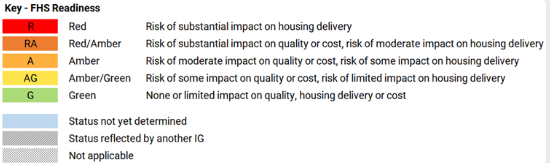
The Provisional Overall Readiness Status is Amber/Green.
The implications of the FHS publications have been reviewed by all of the IGs and the overall Readiness Status is unchanged as Amber/Green. However, the current direction of travel is of increasing risk which is moving the overall status in the direction of Amber if timely progress across a number of issues is not rapidly made.
Readiness status summary
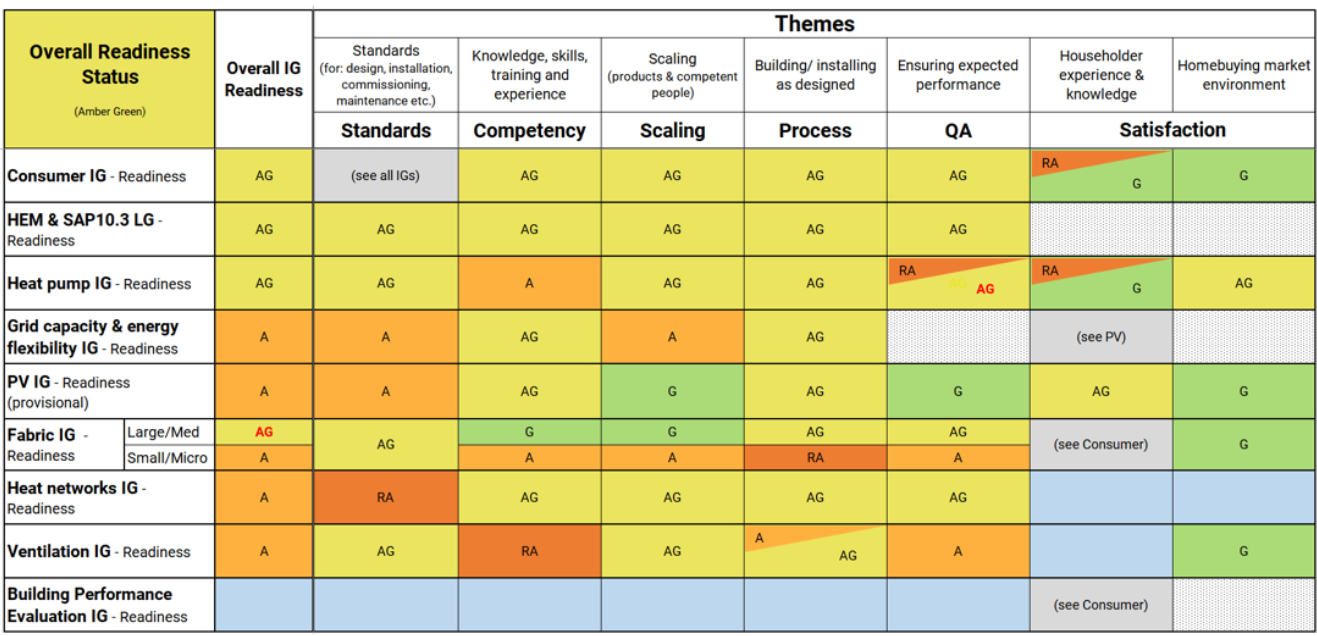
There are seven particular areas to highlight this quarter
1 - FHS publication issues
Continued work to facilitate the resolution of the issues associated with the publication of the FHS documents and SAP10.3.
Informed by the Hub’s cross sector groups, MHCLG published the first set of Frequently Asked Questions alongside slightly updated Part F and Part L Approved Documents. These provided helpful clarifications on a range issues. 22 out of 68 issues were closed out in the period.
Rapid clarification of these issues is critical as homebuilders and the supply chain are having to base their house type design decisions on their assumed interpretations of the regulations which, if not correct, could result in considerable re-work, time delays and ill-judged commercial decisions.
Ultimately Building Control are the arbiter of whether designs comply with the regulations, so they are actively involved in all groups. The expectation is the groups will have progressively developed proposed answers for the majority of the issues by mid-November.
2 - Part L 2026 (FHS) Where to Start Guide – Houses
Work has begun on a ‘where to start’ guide for houses. This will primarily be focused on information to smaller homebuilders but will have wider appeal across medium homebuilders and the supply chain. The guide brings together all aspects of delivering FHS homes in one place, building on the format developed for the Part L 2021 WTS guide. Publication expected Q4 2026.
3 - Development of a range of compliant apartment solutions
Initial feedback from SAP10.3 modelling suggested that achieving FHS compliant solutions for apartment blocks was harder than expected, especially for individual heating solutions. Over the summer a task and finish group has been exploring how 6 different technology approaches perform within SAP10.3 and identify their broader characteristics. This will inform initial feedback to homebuilders and subsequently a Part L 2026 ‘Where to Start’ Guide for apartments due for publication in Q1 2027.
4 - Fabric underperformance
Feedback from warranty providers regarding claims and photo evidence analysis reinforces the concern of fabric underperformance particularly due to poor installation. In homes with low temperature heating these types of defects will be far more apparent to householders through cold rooms or homes, not just higher energy bills. This is not to suggest that fabric construction is getting worse, but any errors which are currently not exposed, due to the extra headroom afforded by high output heat sources, may become more readily apparent and yield complaints. This emphasises the importance of good thermal detail design, building as designed and having appropriate QA processes in place.
5 - Window U values
The manner in which window U-values are being calculated is different in Part L 2026 with the actual window size as well as additional items taken into account such as window bars, sills etc. This brings greater accuracy but in many cases results in a reduction in calculated thermal performance, for smaller windows in particular. The implications are: requirement for individual window U-value calculations, a new set of conventions, updating of all commercial window U-value software and corresponding upgrading of other thermal elements to compensate for the change in calculated window thermal performance. Whilst homebuilders are now receiving individual window U-values for use in SAP the current process is slow and there is a risk of small, but potentially more serious in aggregate, changes whilst the underpinning U-value calculation conventions are being developed.
6 - Ventilation – independent verification
The Ventilation IGs paper ‘Implementing fit for purpose FHS ventilation’ (August 2025) identified research and on-site evidence from across the UK that consistently showed that ventilation systems in new homes were often not designed, installed, or commissioned in line with regulatory requirements, leading to poor performance. The paper proposed how adjustments might be made to improve outcomes. Part F 2026 introduced new wording which requires those commissioning and testing systems to have independent checks of competence, training and, significantly, performance. This latter requirement potentially setting the stage for a low percentage level of independent and unannounced verification tests as recommended in the IG’s report. This random verification process creates installer / commissioner jeopardy to drive competent installations and accurate commissioning. The Hub is working with the ventilation industry, test organisations, home builders, building control and the government to facilitate implementation.
7 - Heat pump Competency Framework and ensuring quality outcomes
Good progress has been made with the approval of the hydronic (wet) heat pump competency framework which implements the Mandatory Technical Competencies (MTCs) and extends the competency specification for individuals installing (or maintaining) and self-certifying hydronic heat pumps. This has been a considerable piece of work and provides the foundations for clearly demonstrating baseline, system-specific competency among those installing under a self-certification scheme.
MCS has also updated their Conformity Assessment Guidelines increasing the number of Technical Supervisors, who also must demonstrate competency against the competency framework, up from one per company.
Whilst these are moves in the right direction, feedback from manufacturers, developers and researchers suggests that it is unlikely these changes will ensure that all (or the vast majority) of heat pump heating systems are designed, installed, and commissioned in a manner to give the required performance.
Whilst there are many good examples of excellent outcomes, further work is needed to determine what actions are required, and by who, to ensure the required level of performance is consistently delivered across all/the vast majority of new homes and will be maintained when the installation rates ramp up rapidly in late 2028.
Readiness status summary assumptions
The following assumptions have been used when considering the FHS Readiness status:
- Part L & F 2026 come into force 24 March 2027
- Bug free version of SAP 10.3 available from July 2026
- HEM is available from October 2026 and compliance is broadly the same as SAP10.3
- For low-rise homes (houses and non HRB apartments), transition period ends 24 March 2028
- For HRBs, transition period ends 24 September 2027 for submission of valid Gateway 2 application
- 30,000 extra housing starts in Q1 2028 (just before the transition period ends)
(for reference, just before the end of Part L 2021 transition period there were circa 40,000 extra starts)
- New homes take 9-12 months to complete on average
- All new houses and non-HRB homes commenced after 24 March 2028 to FHS
- All HRBs submitted to Gateway 2 after 24 September 2027 to FHS
Notes:
- Some of these assumptions have greater readiness sensitivity than others.
- These are strictly FHH proposed assumptions and do not imply any endorsement from government in any way.